
On this page
Ranjana found fur on the sofa cushions, inside her morning tea cup, and pressed flat against the glass of the kitchen window. Her two-year-old Labrador, Bruno, was shedding so steadily that the lint roller had become a permanent fixture next to the front door.
She fed him well. She walked him daily. Yet every monsoon and every summer, the shedding picked up, the coat looked rougher, and she started wondering if something was missing from his diet. It was the right question. The answer sat in the space between grooming routine, daily food, and one specific group of fatty acids most home-cooked meals leave out.
What helps support a Labrador's skin and coat?
Labradors naturally shed heavily because of their dense double coat. The useful goal is not to stop normal shedding, but to support healthy skin, coat quality and grooming ease. A complete diet, regular brushing and appropriate omega-3 intake can help. Patchy hair loss, redness or intense itching deserves veterinary attention.
Why do Labradors shed so much?
Labrador Retrievers carry a double coat. The outer layer is short, dense and slightly oily. The undercoat beneath it is soft and insulating. Together, these two layers protected Labs during cold-water retrievals in Newfoundland, where the breed originated.
That double coat still works as designed. It regulates temperature, repels water and shields the skin from sun and insects. But it also follows a growth cycle. Hair grows, rests, falls out and gets replaced. In Labradors, this cycle moves faster than in single-coated breeds.
Twice a year, Labs go through a heavier shed called "blowing coat." During Indian summers and monsoons, this can feel relentless. Fur collects on clothes, furniture and floors in ways that regular sweeping barely controls.
Good to know
Shedding itself is not a problem. It is part of a healthy coat cycle. The question worth asking is whether the fur falling out is being replaced by strong, smooth, well-nourished hair, or whether the new growth looks thin, dry or patchy.
What makes a Labrador's coat healthy versus dull?
A healthy Lab coat lies flat, feels smooth to the touch and has a slight natural sheen. The skin beneath should be supple, not flaky or red.
When the diet lacks certain nutrients, the coat is the first place the body cuts costs. Skin cells turn over every three weeks. They need a steady supply of protein, zinc, B vitamins and, most critically, essential fatty acids. Without these, hair grows brittle, breaks easily and sheds faster than the body can replace it.
This gap is common in Indian homes. Rice-and-chicken meals provide protein and energy, but they rarely deliver enough omega-3 fatty acids for a large, heavy-shedding breed like the Labrador.
Which nutrition supports a healthy double coat?
The two fatty acids that matter most for canine skin and coat health are EPA (eicosapentaenoic acid) and DHA (docosahexaenoic acid). Both are omega-3 fatty acids found in marine sources, primarily cold-water fish.
EPA supports a healthy inflammatory response in the skin. DHA contributes to cell membrane structure, which affects how flexible and resilient skin cells remain as they turn over. According to the National Research Council's nutrient requirements for dogs, omega-3 fatty acids play a role in maintaining normal skin barrier function.
For a large breed like the Labrador Retriever, daily omega-3 intake matters more than occasional doses. The skin and coat do not store these fatty acids long-term. They need a regular supply.
Where do omega-3s come from in a dog's diet?
Plant-based omega-3 (ALA, from flaxseed or chia) needs to be converted into EPA and DHA inside the body. Dogs convert ALA poorly. Studies suggest the conversion rate sits below 10% for most breeds.
Marine-sourced omega-3 skips this problem. Wild-caught salmon oil delivers EPA and DHA in a form the body can use directly. This is why salmon oil for Labrador skin and coat care has become one of the most searched supplements among Indian dog parents.
Nutrients that support skin and coat health in Labradors
| Nutrient | Role in skin and coat | Common source |
|---|---|---|
| EPA (omega-3) | Supports healthy inflammatory response in skin | Salmon oil, fish oil |
| DHA (omega-3) | Supports cell membrane integrity | Salmon oil, fish oil |
| Zinc | Supports skin cell turnover | Meat, eggs, pumpkin seeds |
| Biotin (B7) | Supports keratin production (hair protein) | Egg yolks, liver |
| Protein | Structural building block for hair and skin | Chicken, fish, eggs |
| Vitamin E | Antioxidant protection for skin cells | Sunflower oil, spinach |
How should grooming and omega-3 work together?
Brushing removes dead hair from the undercoat before it ends up on your furniture. Omega-3 supports the quality of the new hair growing in to replace it. One handles the outside. The other works from within. They are partners, not substitutes.
A practical routine for Labrador coat care
Brushing: Three to four sessions a week with a slicker brush or undercoat rake. During heavy shedding seasons (April through June, and again in September through November in most Indian climates), daily brushing helps.
Bathing: Once every four to six weeks with a mild dog shampoo. Overbathing strips the natural oils that keep a Lab's coat water-resistant. If Bruno smells fine and the coat looks clean, he does not need a bath yet.
Omega-3 as a daily routine: A measured dose of salmon oil added to the morning meal. Pump it onto food, mix briefly, serve. The consistency matters more than the size of any single dose. Skin cells turn over on a rolling cycle, so they need a daily supply.
Routine tip
Keep brushing sessions short and positive. Five minutes is enough for a daily session. If your Labrador resists, brush after a walk when energy levels are lower. Pair it with the salmon oil meal so both become part of the same easy routine.
What to expect over time
Coat improvements from omega-3 supplementation typically become noticeable over four to six weeks of consistent daily use. The first signs are usually softer fur texture and less dry, flaky skin. Shedding volume may reduce, but it will not stop. Labs shed. That is the breed.
Results vary by individual dog, diet, climate, age and overall health. A Labrador living in a Bengaluru apartment with air conditioning will have a different shedding pattern than one in a Delhi home without climate control.
When is shedding not normal?
Normal shedding is even, gradual and distributed across the body. The hair falls out and new hair grows in its place. The skin underneath looks healthy.
Abnormal shedding looks different. Watch for these signs:
- Bald patches where fur is not growing back
- Redness, bumps or sores on the skin
- Persistent scratching, licking or biting at one area
- Fur that breaks off rather than falls out naturally
- Sudden, severe increase in shedding
- Flaky, crusty or darkened skin
- Foul smell from the coat or skin folds
These signs can point to allergies, fungal infections, parasites, hormonal imbalances or nutritional deficiencies. Some are simple to address. Others need diagnostic testing. None of them should be diagnosed through a blog post.
If your Labrador shows patchy hair loss, intense itching, redness or skin odour, please consult your veterinarian. These signs may indicate an underlying condition that needs clinical diagnosis and treatment. This article is educational, not a substitute for veterinary care. Supplements support health; they do not treat, cure or diagnose disease
Daily omega-3 as part of the routine
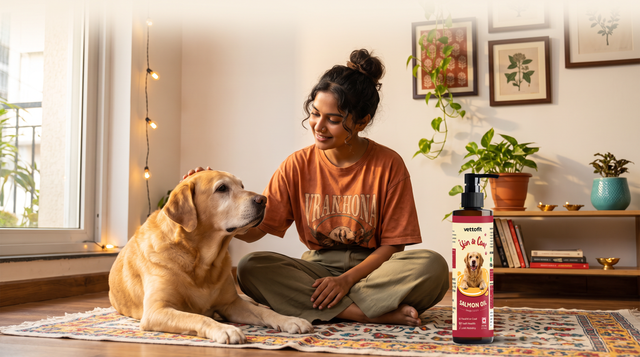
For Labrador parents looking for a consistent, measured source of EPA and DHA, Vettofit Wild-Caught Alaskan Salmon Oil is formulated as a daily dog shedding control supplement. It is wild-caught (not farmed), vet-approved, and third-party tested. One pump onto the morning meal. That is the entire routine. Pair it with regular brushing, and the coat has what it needs from both sides.
#CareWithVettofit
Daily skin and coat support for Labs
Vet-approved. Wild-caught Alaskan salmon oil. One pump on food daily.
Explore salmon oilFrequently asked questions
How much salmon oil should I give my Labrador daily?
Follow the dosage on the product label, as it varies by body weight. Most salmon oil supplements for dogs use a pump-based system sized for the dog's weight range. For adult Labradors (25 to 36 kg), this typically means one to two pumps per day. Always start with the lower dose and observe for a week before adjusting.
Can salmon oil stop my Labrador from shedding?
No supplement can stop a Labrador from shedding. Shedding is a natural part of the double-coat hair cycle. Omega-3 from salmon oil supports the quality and strength of the new coat growing in, which may reduce the amount of loose, broken fur. The goal is healthier shedding, not zero shedding.
Is omega-3 good for dogs with itchy skin?
EPA, an omega-3 fatty acid found in salmon oil, supports a healthy inflammatory response in the skin. This may help dogs with mild, diet-related skin dryness. However, persistent itching, redness or hot spots can signal allergies, infections or other conditions that require veterinary diagnosis and treatment.
What is the difference between fish oil and salmon oil for dogs?
Fish oil is a broad category that includes oils from various marine species. Salmon oil is a specific type of fish oil. Wild-caught salmon oil tends to have a favourable ratio of EPA to DHA and is often preferred for skin and coat support because of its fatty-acid profile. Look for wild-caught sourcing rather than farmed to reduce environmental contaminant exposure.
How long does salmon oil take to show results on a dog's coat?
Most pet parents report noticing softer fur and less flaking within four to six weeks of consistent daily use. Coat shine improvements may take slightly longer. Results vary based on the dog's existing diet, age, health status and the severity of any nutritional gaps. Consistency matters more than dose size.
Can I give salmon oil to my Labrador puppy?
Omega-3 fatty acids are generally considered safe for puppies, but dosing differs from adults. Always check the product label for puppy-specific guidance and consult your veterinarian before adding any supplement to a puppy's diet, especially if the puppy is under six months or on a vet-prescribed feeding plan.
Does my Labrador need a supplement if already eating commercial kibble?
Many commercial kibbles meet baseline nutritional requirements but may not provide optimal levels of EPA and DHA for a heavy-shedding breed. Omega-3 content can also degrade during kibble processing and storage. A daily salmon oil supplement can help bridge that gap. Discuss your dog's specific diet with your vet to decide what fits.
What is the best supplement for dog itching and scratching?
The best supplement for dog itching and scratching depends on the cause. For diet-related skin dryness, an omega-3 fatty acid supplement (like salmon oil rich in EPA and DHA) supports the skin barrier. For itching caused by allergies, infections or parasites, a supplement alone will not resolve the issue. Consult your veterinarian for a proper diagnosis before choosing any product.
Last updated: September 2026