
On this page
No, coconut oil and flaxseed cannot replace fish oil for dogs. Coconut oil contains zero omega-3 fatty acids. Flaxseed provides only alpha-linolenic acid (ALA), and dogs convert ALA to EPA at rates below 5 to 10 percent. Only a marine source like salmon oil delivers EPA (eicosapentaenoic acid) and DHA (docosahexaenoic acid) in a form your dog can actually use.
What are EPA and DHA, and why does your dog need them?
A few years ago, a pet parent in Hyderabad messaged a popular dog forum at midnight. Her Labrador had been scratching non-stop for weeks. She had tried coconut oil, neem baths, even a turmeric paste. Nothing changed. When her vet finally ran a full panel, one thing stood out: her dog's diet had almost no EPA or DHA.
Her story is common. And the fix is surprisingly specific.
EPA and DHA are two long-chain omega-3 fatty acids that your dog's body needs but cannot produce on its own. EPA stands for eicosapentaenoic acid. DHA stands for docosahexaenoic acid. Both come primarily from marine sources, especially cold-water fatty fish like salmon, mackerel, and sardines.
They do different jobs. EPA manages inflammation throughout the body. It helps regulate the immune response in your dog's skin, joints, and gut lining. When EPA levels are adequate, the body produces fewer pro-inflammatory compounds called prostaglandins and leukotrienes. This is why veterinary dermatologists often look at omega-3 intake early when treating dogs with chronic skin issues.
DHA plays a structural role. It forms a key part of cell membranes in the brain, retina, and nervous system. For puppies, DHA supports cognitive development. For senior dogs, it helps maintain brain function as they age. A 2012 study published in the Journal of the American Veterinary Medical Association found that puppies fed DHA-enriched diets showed measurably better learning and trainability compared to controls.
Put simply
EPA keeps inflammation in check. DHA builds and protects the brain and eyes. Your dog needs both, and both come almost exclusively from marine fat.
Does coconut oil contain omega-3?
This is the single biggest misconception on Indian pet forums right now, and it needs a clear answer: coconut oil contains no omega-3 fatty acids at all.
Coconut oil is roughly 82 percent saturated fat, primarily medium-chain triglycerides (MCTs) like lauric acid, caprylic acid, and capric acid. MCTs have some uses. They provide quick energy and may have mild antimicrobial properties on the skin surface. Some pet parents in India use coconut oil topically on dry noses or rough paw pads, and for that external use, it can help.
But here is where the confusion causes real problems. Coconut oil has zero EPA. Zero DHA. Zero ALA. It belongs to a completely different family of fats.
| Fat source | EPA | DHA | ALA | Primary fat type |
|---|---|---|---|---|
| Coconut oil | None | None | None | Saturated (MCTs) |
| Flaxseed oil | None | None | High | Omega-3 (ALA only) |
| Salmon oil | High | High | Trace | Omega-3 (EPA + DHA) |
When someone on a WhatsApp group tells you to "add coconut oil for omega-3," they are mixing up two completely unrelated types of fat. Coconut oil is not a bad product. It simply does not do what EPA and DHA do. Feeding it as an omega-3 for dogs in India is like taking a multivitamin and assuming it covers a calcium deficiency. Different nutrients, different job.
Why flaxseed does not work as well for dogs
Flaxseed sits in a trickier spot than coconut oil because it does contain an omega-3 fatty acid. The problem is which one.
Flaxseed is rich in alpha-linolenic acid, commonly called ALA. ALA is a short-chain omega-3. To become useful as EPA or DHA, it must go through a multi-step conversion process inside the body. This conversion depends on a specific enzyme called delta-6 desaturase.
Here is the problem: dogs are poor converters. Research on canine ALA metabolism suggests that dogs convert less than 5 to 10 percent of dietary ALA into EPA, and even less into DHA. A 2017 review in the Journal of Animal Science noted that plant-based omega-3 sources like flaxseed and chia fail to raise EPA and DHA blood levels meaningfully in dogs, regardless of dose. The conversion bottleneck at the delta-6 desaturase step limits how much useful omega-3 your dog actually gets.
Think of it this way: ALA is a raw material, not a finished product. Your dog's body can only refine a tiny fraction of it into the EPA and DHA it actually needs. Feeding more flaxseed does not overcome this limit. The enzyme pathway tops out.
This matters in practice. If your dog has dry, flaky skin after monsoon season, or a dull coat that does not respond to grooming, the issue may be an EPA and DHA gap, not a general "omega-3" gap. Flaxseed oil will show up fine on a label as an omega-3 source. But it will not resolve a deficiency that requires the long-chain forms.
So is flaxseed useless for dogs?
Not entirely. Flaxseed provides dietary fibre, some lignans, and a small amount of ALA that may contribute modestly to the overall fatty acid profile. Ground flaxseed can support digestion. But if your goal is to deliver meaningful EPA and DHA to your dog's skin cells, joint fluid, or developing brain, a marine source is the direct path. Flaxseed is the scenic detour that mostly dead-ends.
How much EPA and DHA does a dog actually need?
Numbers help cut through the noise, so here is what veterinary nutrition guidelines suggest.
The National Research Council (NRC) recommends a combined EPA + DHA intake of roughly 30 mg per kilogram of body weight per day for adult dogs for general maintenance. Dogs with inflammatory skin conditions, joint stiffness, or cognitive decline in senior years may benefit from higher levels, typically in the range of 50 to 100 mg per kilogram per day, based on veterinary guidance.
| Dog weight | General maintenance | Skin and coat support |
|---|---|---|
| 5 kg (Pomeranian) | ~150 mg EPA+DHA | ~250 to 500 mg |
| 10 kg (Indie, Beagle) | ~300 mg EPA+DHA | ~500 to 1,000 mg |
| 25 kg (Labrador) | ~750 mg EPA+DHA | ~1,250 to 2,500 mg |
| 35 kg (Golden Retriever) | ~1,050 mg EPA+DHA | ~1,750 to 3,500 mg |
Look at those numbers and think about what it would take to reach them with flaxseed, given a conversion rate of 5 to 10 percent. A 25 kg Labrador needing 750 mg of EPA+DHA daily would require the ALA equivalent of around 7,500 to 15,000 mg, which translates to several tablespoons of flaxseed oil every day. That is a lot of extra calories, and most of it will not convert anyway.
A quality salmon oil, by contrast, delivers EPA and DHA directly. No conversion needed. The serving size stays small, the calorie load stays low, and the fatty acids arrive in the exact form your dog's body can absorb and use.
Where do Indian home diets fall short on EPA and DHA?
Most dogs in India eat some combination of home-cooked food and commercial kibble. Both have the same gap when it comes to long-chain omega-3 fatty acids.
Roti + rice + dal
The backbone of most Indian home diets for dogs. These provide carbohydrates and some plant protein, but virtually zero EPA or DHA. The cooking oils used, typically sunflower, mustard, or groundnut, are high in omega-6 and contain no marine omega-3.
Chicken and egg
Good protein sources. But poultry fat is rich in omega-6 (linoleic acid), not omega-3. Eggs contain a tiny amount of DHA, roughly 25 to 50 mg per egg depending on the hen's diet. Not enough to meet a medium or large dog's daily needs.
Curd and paneer
Common in many Indian dog diets for digestion and palatability. Dairy fat is primarily saturated. It provides no meaningful EPA or DHA. Good for probiotics and calcium, but not for omega-3.
Standard kibble
Most affordable kibble brands in India use chicken fat or vegetable oils as the primary fat source. Unless the formula specifically lists fish oil or fish meal, the EPA and DHA content is minimal or absent. Check the label for the specific fatty acid breakdown, not just "crude fat."
This does not mean Indian home diets are bad. Many pet parents feed nutritious, balanced home meals. The point is narrower: the specific long-chain omega-3 fatty acids EPA and DHA are scarce in terrestrial food sources. They evolved in the marine food chain. Algae produce them. Fish eat algae and concentrate them. That is the path.
If you cook at home for your dog, adding a marine omega-3 source is one of the most targeted nutritional upgrades you can make. It fills a gap that no amount of turmeric, coconut oil, or flaxseed can fill on its own.
The source matters: not all fish oils are the same
Once you know your dog needs EPA and DHA from a marine source, the next question is which source. Not all fish oils deliver the same quality or concentration.
Wild-caught versus farmed
Wild-caught fish, especially cold-water species like Alaskan salmon, tend to have higher omega-3 concentrations and lower contaminant levels compared to farmed fish. Farmed salmon are often fed grain-based diets that raise their omega-6 content and reduce the omega-3 ratio. Wild-caught Alaskan salmon oil, sourced from clean, cold Pacific waters, provides a more favourable EPA-to-DHA profile.
What to look for on the label
A good EPA DHA supplement for dogs in India should list the EPA and DHA content per serving in milligrams, not just "total omega-3." Total omega-3 can include ALA and other less useful fatty acids. The numbers that matter are EPA mg and DHA mg.
Also check for third-party testing. Heavy metals like mercury and lead can accumulate in fish. A tested product gives you a verifiable safety floor.
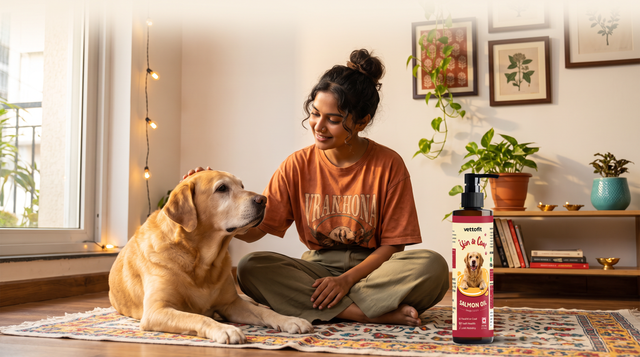
Vettofit Wild-Caught Alaskan Salmon Oil lists its EPA and DHA per serving clearly on the label and is third-party tested for purity. It uses wild-caught Alaskan salmon as its single marine source. You can check the full ingredient panel and fatty acid breakdown on the product page.
If your dog's coat needs attention, skin and coat improvements with a marine omega-3 source typically become visible over a 4-week period. Some dogs respond faster, some take a bit longer. Results depend on your dog's starting condition, breed, diet, and overall health. Read more about how protein and zinc work alongside omega-3 for the coat.
Omega-3 supplements support skin, coat, joint, and cognitive health, but they are supplements, not medications. If your dog has persistent itching, hair loss, or skin lesions, please see your veterinarian for a proper diagnosis before starting any supplement. Some skin conditions require specific medical treatment, and a supplement alone will not resolve them. Always introduce any new supplement gradually and watch for digestive changes in the first few days.
Frequently asked questions about EPA, DHA, and omega-3 for dogs
Can coconut oil or flaxseed replace fish oil for dogs?
No. Coconut oil contains zero omega-3 fatty acids. It is made of saturated medium-chain triglycerides. Flaxseed contains ALA, a short-chain omega-3, but dogs convert less than 5 to 10 percent of ALA into the EPA and DHA their body actually uses. Only a marine source like salmon oil provides EPA and DHA directly.
What is the difference between ALA, EPA, and DHA?
ALA (alpha-linolenic acid) is a short-chain omega-3 found in plants like flaxseed and chia. EPA (eicosapentaenoic acid) and DHA (docosahexaenoic acid) are long-chain omega-3 fatty acids found in marine sources. Dogs need EPA and DHA for skin health, joint support, and brain function. ALA requires enzymatic conversion to become EPA or DHA, and dogs perform this conversion very poorly.
How much EPA and DHA should I give my dog daily?
The NRC suggests roughly 30 mg of combined EPA + DHA per kilogram of body weight per day for general health. Dogs with skin or joint issues may benefit from 50 to 100 mg per kilogram, but always check with your vet before increasing above maintenance levels. Your dog's breed, weight, age, and health status all affect the ideal dose.
Is coconut oil safe for dogs even though it has no omega-3?
Small amounts of coconut oil are generally safe for most dogs and can be useful as a topical moisturiser for dry skin or paw pads. Internally, it provides quick-energy MCTs. But it should not be used as a substitute for a marine omega-3 supplement. It fills a different nutritional role entirely, and feeding too much can add unnecessary saturated fat and calories.
Why is wild-caught salmon oil better than farmed salmon oil?
Wild-caught salmon eat a natural diet of smaller fish and krill, which concentrates their EPA and DHA levels. Farmed salmon are often fed grain-based feed, which increases omega-6 and reduces the omega-3 ratio. Wild-caught sources also tend to have lower contaminant levels. Alaskan wild-caught salmon is considered one of the cleanest marine omega-3 sources available.
Can I give flaxseed alongside fish oil for extra benefit?
Yes, ground flaxseed can complement fish oil. It adds fibre and lignans to your dog's diet, which support digestion. But the omega-3 benefit should still come primarily from the fish oil (EPA and DHA). Think of flaxseed as a digestive aid and fish oil as the omega-3 source. They are not interchangeable for that purpose.
How long before I see coat improvements from salmon oil?
Most pet parents notice visible changes in coat texture and shine within 3 to 4 weeks of daily supplementation with a marine omega-3 source. Some dogs respond within 2 weeks, especially if the starting diet was very low in EPA and DHA. Full coat cycle turnover takes longer, so continued supplementation over 2 to 3 months gives the most complete results. Results vary by breed, diet, and individual health.
Do Indian home diets provide enough omega-3 for dogs?
Typical Indian home diets built around roti, rice, dal, chicken, and curd provide good nutrition overall but are very low in marine omega-3. The cooking oils commonly used (sunflower, mustard, groundnut) are rich in omega-6 but contain no EPA or DHA. Adding a small daily serving of a quality salmon oil is one of the simplest ways to fill this specific gap without changing your dog's entire diet.