
On this page
Last reviewed: July 2026 · Educational content, not a substitute for veterinary diagnosis.
Your dog scratches through the night. A few flakes turn up wherever you pet them. The vet says "dry skin," you walk out with a bottle of coconut oil, and a few weeks later, not much has changed.
Here is the part that usually gets left out: flaky skin is rarely a moisture problem on its own. It is more often a sign that your dog's skin barrier, the protective layer sitting on top of the skin, has broken down. Once that layer weakens, water escapes, irritants get in, and the itching, flaking and infections that follow are not separate problems. They are the same problem showing up in different ways.
A dog's skin barrier is the outermost layer of cells and fats that locks moisture in and keeps allergens, bacteria and yeast out. When it weakens, water escapes faster and irritants get in more easily. That is why flaking, itching and skin infections usually show up together, not as separate problems.
What is the skin barrier?
The skin barrier is the stratum corneum, the outermost layer of a dog's skin. It is built from flattened skin cells called corneocytes, held together by a layer of fats made mostly of ceramides, cholesterol and fatty acids. Vets often describe it with one simple image: bricks and mortar.
Picture a brick wall. The corneocytes are the bricks. The lipid layer sitting between them, made largely of ceramides, is the mortar. Neither part works alone. Bricks without mortar let water pour straight through the gaps. Mortar without bricks has nothing to hold together. A healthy barrier needs both, in the right proportions.
This layer sits on top of the epidermis, one of the layers that make up your dog's skin, the body's largest organ. Its job sounds simple but carries real weight: hold water inside the body, and keep everything else outside. Allergens, dust, pollen, bacteria and yeast from the environment are all meant to stop here, before they reach the living tissue underneath.
| Term | What it means in plain terms |
|---|---|
| Stratum corneum | The outer layer of skin cells that forms the barrier |
| Ceramides | Fatty molecules that hold barrier cells together, the "mortar" |
| Corneocytes | Flattened skin cells, the "bricks" of the barrier |
| Transepidermal water loss (TEWL) | The rate at which water escapes through the skin |
| Skin microbiome | The community of bacteria and yeast that live on healthy skin in balance |
When this layer is intact, a dog's coat looks smooth, the skin feels supple, and there is no real reason to scratch. When it is compromised, several problems tend to arrive together, which is exactly what the next section covers.
Why does a damaged barrier itch and flake?
A damaged barrier lets water escape faster than normal, a process called transepidermal water loss, which dries out and flakes the surface. At the same time, the same gaps let allergens and bacteria reach the nerve endings and immune cells underneath, which triggers itching and inflammation. Both symptoms come from one underlying defect, not two separate causes.
Veterinary dermatology research backs this up directly. Studies measuring transepidermal water loss in dogs with skin disease have found it consistently higher than in dogs with healthy skin, alongside lower and disorganised ceramide levels in the outer skin layer, according to a peer-reviewed review in Veterinary Immunology and Immunopathology. Fewer ceramides mean patchier mortar between the bricks. Patchier mortar means water leaves faster, which shows up as flaking and a dull coat, and allergens and microbes get in more easily, which shows up as itching, redness and, in some dogs, secondary infection.
There is also a feedback loop worth knowing about. Scratching itself damages the barrier further, which lets in more irritants, which causes more itching. This is one reason mild skin issues can snowball into something bigger if the barrier itself is never addressed.
| Healthy barrier | Weakened barrier |
|---|---|
| Smooth, supple skin | Flaky, rough or dull patches |
| Low, steady water loss | Higher water loss, dryness returns quickly after moisturising |
| Allergens and microbes stay outside | Allergens and microbes trigger itching and inflammation |
| Balanced surface microbiome | Yeast or bacteria can overgrow, leading to odour |
What damages it in Indian conditions?
In India, the biggest disruptors of a dog's skin barrier are humidity that traps moisture in skin folds and paws, frequent bathing with harsh or human shampoo that strips natural oils, sudden shifts between air-conditioned indoor air and outdoor heat, and home diets that fall short on essential fatty acids. Each of these thins or dries out the same lipid layer, from a different direction.
Monsoon humidity. Once relative humidity crosses roughly 80 percent, which is common across much of India through July and August, a dog's coat barely dries between walks. Moisture stays trapped in the paws, ear folds, armpits and belly, and that warm, damp environment is exactly what yeast and bacteria need to multiply. This is a large part of why skin complaints spike during monsoon season across Indian vet clinics.
Over-bathing. Bathing too often, or using a harsh or human shampoo, strips the natural oils the barrier depends on. Human shampoo in particular is formulated for a different skin pH than a dog's, so it can do more harm than good here.
Heat and air conditioning. Long stretches in air-conditioned rooms followed by dry outdoor heat pull moisture from the skin in a way that mirrors what dry winter air does to human skin, just compressed into a single Indian summer day.
Home diets. Roti, rice and curd based meals, common in many Indian households, can be calorie-adequate while still running short on the essential fatty acids the skin needs continuously. The skin cannot store much of a fat reserve for barrier repair, so a steady daily supply matters more than an occasional oily meal.
If persistent itching, rather than flaking, is the main concern right now, our guide on dog skin itching in India goes deeper into causes and natural remedies.
Which nutrients does barrier repair need?
Barrier repair mainly needs essential fatty acids, particularly the omega-3s EPA and DHA, along with zinc, biotin and vitamin E. Omega-3s help rebuild the fatty part of the barrier and calm inflammation from the inside, while zinc and biotin support new skin cell and keratin production, and vitamin E protects those fats from oxidative damage.
| Nutrient | Role in barrier repair | Common source |
|---|---|---|
| Omega-3 (EPA & DHA) | Rebuilds the lipid layer, lowers inflammatory signalling | Fish oil, algae oil |
| Omega-6 (linoleic acid) | Structural fat in the outer skin layer, needed in balance with omega-3 | Vegetable oils, poultry fat |
| Zinc | Supports new cell growth and wound healing | Organ meat, eggs |
| Biotin | Cofactor for keratin, the main protein in skin and coat | Egg yolk, liver |
| Vitamin E | Antioxidant, protects skin fats from breakdown | Vegetable oils, seeds |
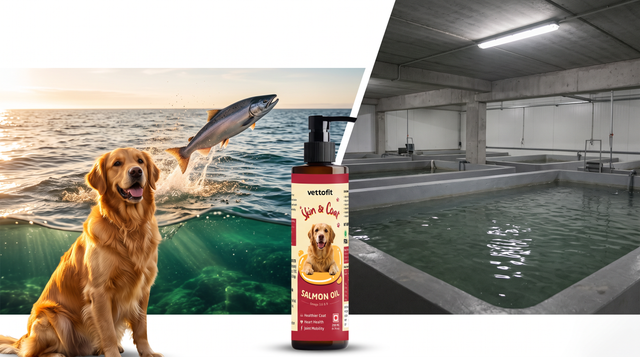
Among these, omega-3s from fish oil have the most consistent evidence in dogs, backed by peer-reviewed veterinary research rather than marketing claims alone. For pet parents looking for a daily source, Vettofit Wild-Caught Alaskan Salmon Oil is formulated as an EPA and DHA source for this reason, though any omega-3 supplement should sit alongside, not replace, a complete and balanced diet.
Hair fall and coat thinning often overlap with barrier issues but are not always the same thing. If that is your dog's main concern, see our dedicated guide on dog hair fall in India.
How long does repair take?
Most dogs need four to eight weeks of consistent nutrient support before an owner notices a real difference in skin and coat. This lines up with how skin renews itself, roughly every three to four weeks, so one full turnover cycle, sometimes two, is a realistic timeline rather than a shortcut.
A study published in the Journal of the American Veterinary Medical Association found measurable improvement in itching, coat character and skin condition in dogs given daily EPA and DHA over a six-week period. Other controlled trials have shown clinical scores improving from around day 30, with results levelling off by day 60 to 90 of steady supplementation. The exact timeline still depends on the dog: severity of the underlying issue, any allergy involved, coat type and how consistently the food or supplement is given all affect how fast change shows up. Results vary by dog, and a realistic timeline is more useful than a promise of speed.
A simple daily routine to support the barrier
- Feed at the same time each day, with the same food, so the gut and skin are not managing extra stress from frequent diet changes.
- Add a vet-approved daily source of omega-3, and give it a full four to eight weeks before judging whether it is working.
- Dry your dog fully after every walk or bath, paying attention to paws, ear folds, armpits and the belly.
- Space out baths to roughly once every two to three weeks unless your vet has advised otherwise, using a mild, pH-balanced dog shampoo.
- Keep a simple weekly photo or note of the coat and skin, so you and your vet can track real change instead of relying on memory.
When is it a vet visit?
See a vet if you notice open sores, a sudden red and oozing patch, hair loss in patches, a strong odour, thickened or darkened skin, or no improvement after four to six weeks of consistent diet and grooming changes. These signs usually point to an infection or an underlying condition that food and grooming alone will not resolve.
Vet note
If your dog shows any of the signs above, please consult your veterinarian. This article is educational and does not replace a professional diagnosis. Thickened, hardened patches over pressure points like the elbows are usually a separate issue, calluses rather than barrier damage, and our guide to elbow calluses explains when those need attention.
Frequently asked questions
The skin barrier is the outer layer of skin that holds moisture in and keeps allergens, bacteria and yeast out. Think of it as a wall of skin cells held together by fats. When it weakens, water escapes and irritants get in more easily.
Mild, occasional flaking often responds well to consistent diet and grooming changes over several weeks. If you see sores, hair loss, odour, or no change after four to six weeks, a vet visit is the right next step, since these can point to an infection or allergy that needs targeted treatment.
Studies on dogs typically show visible improvement in coat and skin quality starting around four weeks, with more consistent results by six to eight weeks of daily supplementation. Results vary by dog, diet and the underlying cause of the skin issue.
High humidity keeps a dog's coat and skin damp for longer after walks and baths. That trapped moisture creates the warm, damp conditions yeast and bacteria need to multiply, which is why skin issues in paws, ear folds and skin creases spike during the rainy season in India.
Coconut oil applied to the surface in small amounts can offer mild support, but it is not a substitute for the essential fatty acids the barrier needs from the diet. It also will not resolve barrier damage caused by an underlying allergy or infection.
Yes. Frequent bathing, or bathing with a harsh or human shampoo, strips the natural oils the barrier depends on. Most healthy dogs do well with a bath roughly every two to three weeks, using a mild, pH-balanced dog shampoo, unless a vet has recommended a different schedule.
Small amounts of oily fish, eggs, and a vet-approved fish oil supplement can add essential fatty acids that many home diets, especially roti, rice and curd based meals, do not fully provide. Any dietary change should be introduced gradually and ideally discussed with your vet.
No. Flaking can come from allergies, but also from nutrient gaps, harsh grooming products, humidity, or normal seasonal shedding. A vet can help tell these apart, especially if flaking comes with itching, odour, or a change in skin colour.