
On this page
You know the sound — the constant scratch-scratch at 2 AM. Your dog's fur is thinning near the ears, the tail, the belly. You have tried changing their shampoo. You have read conflicting advice on three different WhatsApp groups. And you are still left wondering: why is my dog scratching so much?
You are not alone. Dog skin itching is one of the most common concerns among Indian pet parents — and one of the most misunderstood. India's humidity, heat, dust, and dietary habits create a perfect storm for canine skin problems. The good news: most causes are identifiable, and most remedies are accessible.
This guide walks you through 7 clinically recognised causes of dog skin itching in India, what vets look for in each case, and the natural remedies that actually help — with honest timelines.
In this article
Why dog skin itching is so common in India
India's climate creates conditions that most Western pet care research does not fully account for. A 2022 study published in Veterinary Dermatology found that environmental allergens — including dust mites, mould spores, and grass pollens — are among the leading triggers of canine atopic dermatitis globally, and these allergens are present year-round in Indian cities like Bangalore, Mumbai, Delhi, and Chennai.
At the same time, a large proportion of Indian dogs eat homemade food — rice, dal, chicken curry — which, while lovingly made, often lacks the essential fatty acids that keep skin healthy. Commercial kibble without omega-3 supplementation can fall short too.
7 causes of dog skin itching in India
Not all itching looks the same — and not all itching has the same cause. Here are the 7 most common reasons Indian vets see dogs presented for skin scratching.
Food allergies and intolerances
Food allergy is one of the top three causes of chronic itching in dogs. Unlike humans, dogs typically react to proteins, not grains. The most common culprits: chicken, beef, dairy, wheat, and eggs. In India, where chicken is a staple in both homemade and commercial dog food, this is frequently overlooked.
A food allergy does not develop immediately. It usually takes months or years of regular exposure to a protein before the immune system mounts a reaction. So a dog who has eaten the same food for 2 years can still develop an allergy to it.
Signs: Itching around the face, paws, ears, and belly. Year-round, not seasonal.Environmental allergens (atopic dermatitis)
Atopic dermatitis is an inherited predisposition to react to environmental allergens — dust mites, pollen, mould, and grass. In a city like Bangalore with its year-round greenery, or Mumbai's humidity, these allergens are nearly unavoidable. The skin's barrier function weakens, allowing allergens to penetrate and trigger an immune response.
Breeds with a genetic predisposition include Labradors, Golden Retrievers, Bulldogs, and German Shepherds — all highly popular in India.
Signs: Seasonal flare-ups. Red, inflamed skin between toes, armpits, groin, and around eyes.Nutritional deficiencies, especially omega-3
The skin barrier needs dietary fat to stay intact. Omega-3 fatty acids — specifically EPA and DHA — are the building blocks of healthy skin cell membranes. When a dog's diet is low in these, the skin becomes dry, flaky, and easily irritated. This is common in both plain homemade food and many commercial kibbles.
Zinc deficiency is another factor: zinc supports wound healing and immune function in skin tissue. Deficiency-related dryness affects all breeds.
Signs: Dry, dull coat. Flaking. Generalised itching without redness or swelling.Fleas, ticks, and mites
India's warm climate is ideal for flea and tick populations. Flea allergy dermatitis (FAD) is actually an allergy to flea saliva — meaning even a single flea bite can cause intense, widespread itching in a sensitised dog. Mange mites (Sarcoptes or Demodex) are another common cause, particularly in young dogs or those with weakened immunity.
This is the most important cause to rule out first, because it is the most immediately treatable with the right antiparasitic treatment.
Signs: Intense scratching at the tail base. Hair loss in patches. Visible specks on the skin.Fungal and bacterial skin infections
India's monsoon season creates warm, humid conditions that allow Malassezia yeast and Staphylococcus bacteria to overgrow on the skin. These secondary infections often start because the dog has been scratching and breaking the skin barrier. Dogs with skin folds — Bulldogs, Pugs, and Shih Tzus — are most vulnerable.
Secondary infections require veterinary treatment. Natural remedies alone will not resolve a bacterial or fungal infection.
Signs: Musty smell. Greasy or crusty skin. Redness inside ear canals. Brown paw discolouration.Dry skin from hard water, AC, and fans
Air conditioning and ceiling fans dry out the air significantly. Many Indian cities also have hard water with high mineral content, which strips the skin's natural oils during bathing. This causes transepidermal water loss (TEWL) — a measurable marker of compromised skin barrier function that directly causes itching.
Over-bathing worsens this significantly. Many Indian pet parents bathe dogs weekly in summer — which removes protective sebum from the coat.
Signs: Dandruff. Tight, dry skin after bathing. General scratching without localised inflammation.Contact dermatitis
Dogs can develop a reaction to substances they walk on, sit on, or are bathed with — floor cleaners, synthetic carpets, certain detergents, or lawn pesticides. In urban Indian apartments where phenyl-based floor cleaners are common, paw irritation and belly itching from contact reactions are more frequent than most owners realise.
Contact dermatitis tends to affect hairless or thinly haired areas: the belly, groin, armpits, and paws — wherever the body touches the irritant most.
Signs: Itching on the belly and paws. Redness in a pattern matching contact areas. Improves when indoors.Natural remedies vets recommend for dog skin itching
"Natural remedy" does not mean immediate. Real skin healing takes weeks, not days. These remedies are vet-backed, evidence-informed, and honest about timelines. They work best as part of a consistent routine, not a one-time fix.
Omega-3 fatty acid supplementation
EPA and DHA reduce skin inflammation by modulating the immune response. A 2020 study in PLOS ONE found that omega-3 supplementation significantly reduced pruritus scores in dogs with atopic dermatitis over 8 weeks. Wild-caught fish oil is the most bioavailable source. Expect visible results in 4 to 6 weeks.
Elimination diet trial
Feed a novel protein your dog has never eaten before — duck, rabbit, or kangaroo — for 8 to 12 weeks, avoiding all previous foods. This is the gold standard for diagnosing food allergies. It requires discipline, but it is the only way to definitively confirm or rule out a food trigger.
pH-neutral, medicated bathing
A dog's skin pH (6.2–7.4) is more neutral than human skin (4.5–5.5). Human shampoos disrupt this balance. Switch to a pH-balanced, soap-free dog shampoo — ideally with colloidal oatmeal or aloe vera for sensitive skin. Bathe no more than once every 2 to 3 weeks for most breeds.
Probiotics for gut-skin health
A disrupted gut microbiome can drive systemic inflammation that shows up on the skin. Lactobacillus and Bifidobacterium strains have shown promise in reducing allergic skin responses in dogs. Adding a vet-approved probiotic to daily meals supports the gut-skin axis and is a low-risk addition.
Consistent antiparasitic prevention
If fleas or ticks are even a remote possibility, treat them first. A monthly antiparasitic treatment (oral or topical, as recommended by your vet) eliminates this variable entirely. You cannot meaningfully address skin itching while an active parasite infestation continues.
Managing indoor allergens
Vacuum carpets and dog beds weekly. Wash pet bedding in hot water. Replace floor cleaners with pet-safe alternatives. During high-pollen months, wipe your dog's paws and belly after outdoor walks with a damp cloth. Small environmental changes compound into significant symptom reduction over time.
🌿 A note on turmeric
Curcumin — the active compound in turmeric — has demonstrated anti-inflammatory and antioxidant properties in multiple studies. It can be a helpful supportive addition to your dog's diet for mild skin inflammation. Vettofit's Nutri-Topper includes turmeric as part of its natural formulation. It is not a substitute for veterinary treatment in active infections or severe allergies. Always check with your vet on dosage before adding turmeric.
Things that seem helpful but often make itching worse
Vet-Approved · Wild-Caught · Alaskan Origin
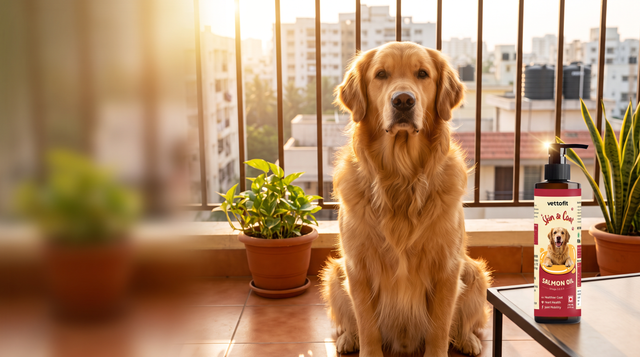
Vettofit Wild-Caught Alaskan Salmon Oil
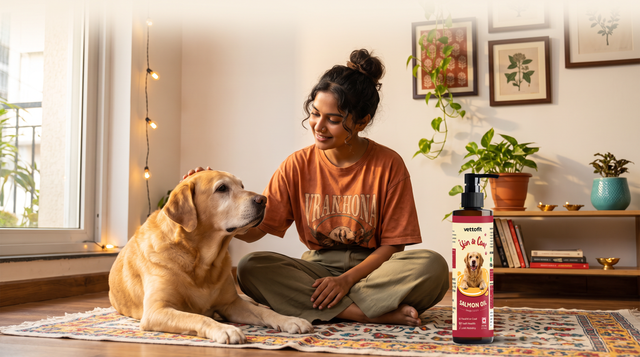
A natural source of EPA and DHA omega-3 fatty acids — clinically studied for reducing skin inflammation and improving coat health. Add it to your dog's meal daily. Most pet parents see a visible change in coat shine within 4 weeks.
Learn More About Salmon OilVet-backed.
Pet-loved.
When to see your vet — and what to expect
Natural remedies and dietary changes take time. But some signs indicate the itching has moved beyond something you can manage at home. Here is a clear guide to help you decide.
| Symptom or Pattern | Home Management | See Your Vet |
|---|---|---|
| Mild scratching, no visible skin change | ✓ Start omega-3, check for fleas | |
| Dandruff or dry, dull coat | ✓ Review diet, add fish oil, reduce bath frequency | |
| Scratching for more than 2 weeks without improvement | ● Professional diagnosis needed | |
| Red, inflamed, or hot skin patches | ● Possible infection — vet treatment required | |
| Hair loss in patches | ● Rule out mange, hormonal issues, infection | |
| Open sores or crusting | ● Urgent — risk of secondary infection spreading | |
| Musty smell from skin or ears | ● Likely yeast or bacterial overgrowth | |
| Paw chewing + ear rubbing together | ● Classic atopic dermatitis — needs allergy workup |
Important: This guide provides educational information — not medical advice. Persistent, worsening, or severe skin itching always requires a professional veterinary diagnosis. Please consult your vet before starting any supplement, diet change, or treatment.
The role of a dog skin and coat supplement
Supplements are not a replacement for veterinary care. But for dogs with mild, nutrition-related itching — or as a supportive tool alongside vet-prescribed treatment — the right dog skin coat supplement can make a real difference.
What to look for in a dog dry skin supplement
🐾 How Vettofit approaches skin health
Vettofit's Wild-Caught Alaskan Salmon Oil delivers EPA and DHA from sustainably sourced, wild-caught salmon — not farmed. It is vet-approved, third-party tested, and designed for Indian dogs. Vettofit's Nutri-Topper combines probiotics, prebiotics, turmeric, and human-grade ingredients to support gut health and skin from the inside out. Both products are gluten-free, preservative-free, and made in India to international standards. Over 1,000 Indian pet parents have made them part of their dog's daily routine.
Frequently asked questions
Watching your dog scratch and not knowing why is genuinely stressful — we understand that. The good news is that most causes of dog skin itching in India are manageable once you know what you are dealing with.
Start by ruling out parasites, then look at diet and nutrition. Give any dietary change or supplement a full 4 to 6 weeks to show results. If things are not improving — or if the skin looks inflamed, infected, or raw — please see your vet.
Your dog's skin is not just about looking good. It is the largest organ in their body. Taking it seriously from the inside out — with the right nutrition and the right support — is one of the most meaningful things you can do for them.
🐾 Also worth exploring
If your dog also shows signs of picky eating, poor coat, or low energy alongside skin issues, Vettofit's Nutri-Topper covers nutritional gaps with human-grade chicken, probiotics, prebiotics, turmeric, and essential vitamins — vet-approved, gluten-free, and made in India. Sprinkle it on any food your dog already eats.
Explore Nutri-TopperShare this
"Dog skin itching in India has 7 common causes — and most are fixable with the right nutrition and care. Read the full vet-backed guide at Vettofit." #CareWithVettofit